Standard Statement
I am committed to meeting all DHS requirements and maintaining required clearances to ensure the safety of children in my care.
Artifact 1- promoting child development and learning
I love to create engaging experiences and activities that support children's growth and development. things like cognitive, social, emotional, physical, and language development are all very important for young children. The activities I plan are play-based and are always age-appropriate for the children in my classroom.
This artifact shows hands-on activity with children. I am confident in my ability to support children's growth through my lesson planning.

Artifact 2- building family and community relationships
I take pride and commitment in building partnerships with families and the community. This helps me support children's learning and development. I encourage parent involvement and respect everyone involved. I feel that each child I care for is a new part of my journey, and I strive to have strong relationships with everyone involved.
This artifact shows a clip of a family I nanny for. I am so grateful for them and love being a part of their circle. Our relationship means the world to me.
from a parent- kiara is an amazing nanny and caretaker, she has truly become a part of our family the past 3 years. she began caring for our daughter when she was just 5 months old and we put our trust into her to care for her. since then she has cared for our two older children as well and always provides exceptional care. we ask our children to describe kiara and they said nice, fun, caring.
Artifact 3- child observation, documentation, and assessment
It is so important to me to take time and adjust learning, lesson plans, and activities to support children's needs and best support their development. I use assessments, documentation, and observation skills to help me better understand each child's needs and development level.
After completing the pqa with a young child i noticed that they struggle to color in the lines. i came up with a lesson plan to practice this skill, and to aid the child in beginning to color in the lines. this can be used in a classroom with many different children, but i did this one on one with the child.
lesson plan: coloring in the lines
learning area: creative arts
materials: paper with shapes drawn out, coloring tools
beginning: encourage child to hold crayons, aid them in how to hold the crayon, have them color on the sheet, offer larger shapes
middle: encouraging children to keep the color inside of the lines, show what inside vs outside the lines is
later: offer sheets with more/smaller details
end of activity: show off our coloring pages, ask about how each child feels

Artifact 4- developmentally, culturally, and linguistically appropriate teaching practices
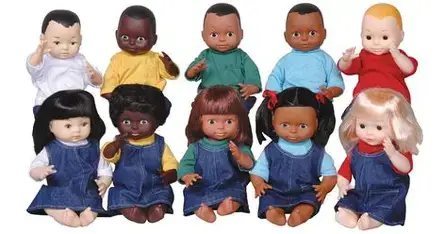
It is always my goal to make my classroom inclusive, and insure that each child feels safe, welcomed, and like they belong. no matter race, ethnicity, abilities, or background, each child will walk in feeling like they are represented, and have a place in my classroom.
This artifact shows one way that i plan to do this, have dolls of different skin tones, hair colors, and features. Another bin will have play figurines of different people with different abilities for example, wheel chair users, hearing aid user, and glasses. this shows how Iam committed to showing up for each child and making sure that they feel seen, and a sense of belonging.
Artifact 5- knowledge, application, and integration of academic content in the early childhood curriculum
i know and understand the importance of using and following the academic guidelines for early childhood education. being able to create lesson plans that are both hands on and engaging, while still adhering to the academic learning goals for the children is my number one goal. learning should be enjoyable, and especially in early childhood i strive to create a life long love for learning for each child.
this artifact shows how i am able to create activities and units that provide many different areas of learning. In this example, children are using hands-on learning by experiencing, and caring for a growing plant. There are so many different learning areas that are provided through this experience, like math, science, and social-emotional health. children learn the life cycle and stages of a plant, patience, and how to care for a living thing. This shows my ability to create age-appropriate learning experiences that align with the curriculum.
growing a plant unit this unit will last 2 weeks+
age group: 4-5
we will learn about how things grow, we will plant our seeds, care for them, observe how the seed grows into a plant. Academically, this will target math, science, and social emotional learning.
by the end of the activity children will
- know parts of a plant
- know what plants need to grow
- observe and keep note of changes in plant
- measure and compare plants growth
- know how to care for a plant
week 1, day 1: what is a plant
- together read a book about a plant
- using book, point to and show different parts of a plant
- label a big plant together on a poster
day 2: how do plants grow
- work together to discuss what plants need to grow
- gather materials (cup, soil, seeds)
- plant seeds together
day 3: observe and predict
- see any changes in our cups
- draw what we think will happen next
etc...
Artifact 6- professionalism as an early childhood educator
This artifact shows my understanding of the different ethical statements, and use the information to help me be the most professionalism I can be. I also use them to be the best I can be in the classroom.
Equity and bias in an early childhood education classroom
Being an early childhood educator means we take on so many different roles and have the ability to make a huge impact on young children and shaping their minds. Young children have minds that are always open and picking up on everything that goes on around them, and as a teacher we must always be mindful of our actions. Modeling certain beliefs, behaviors, and expectations to our students will begin to shape their understandings of themselves and the world around them. With this great influence educators should always be making ethical decisions. The ethical issue that I want to focus on in this paper is equity and bias in early childhood classrooms. Having and even showing bias in a classroom can negatively impact all children in many ways including their wellbeing, learning, and sense of belonging. While looking at the NAEYC code of ethical conduct as a guide, this paper will show the commitment that early childhood educators must take in order to lead young children and promote equity, fair, and respectful relationships between everyone.
Making ethical decisions as a teacher in an early childhood education classroom means acting in ways that support the best for all children. Their best interests, wellbeing, dignity, and rights of children while sticking to professional standards, and your key responsibilities as a teacher. In order to make an ethical choice you have to reflect on how a choice may affect others, not only the children, but parents, families, and other staff members. The NAEYC code of ethical conduct states that ethical decisions should be guided by core values such as respect for diversity, fairness, and the commitment to “do no harm” (NAEYC, 2011). Sometimes you may have to go against your personal beliefs to make the best ethical decision for your classroom.
Equity and bias in an early childhood classroom can look different than equity and bias in the outside world, as young children are still moldable, through their experiences. Equity with young children is things like being fair, and providing experiences, opportunities, and support to all children. Some children may need more support than others, and by giving them the help that they need we are providing them with equity and allowing them to get to the same stage as everyone else, even if they need a little more help. Often people may confuse equity and equality; while helping other students; some students may not get that same support boost at the moment because they just don't need it, and that is still fair. Equality is when each child is treated the exact same, so each child no matter how short, or tall, would have one block to stand on to reach something higher up, while the taller children have a natural advantage. Giving the shorter children a second or third block is support, ensuring all children are on an even starting field, that is equity. Observing disadvantages, and differences, and making a change to help. Bias can happen concessionally, or unconsciously. Things like judging or making assumptions based on a variety of things like race, gender, language, statue, or family background. In any classroom, bias should not be a judging factor of a child, but in some cases, we can see that it is and that is an issue.
While children are not born with bias or judgement against other differences, as they grow the influence of everyone around them can begin to shape a positive or negative bias. Things like parent's beliefs, things they hear from peers, and their teachers, all aid in shaping a child's bias. Research shows that children begin to notice differences in things like race, gender, and ability at a very young age (Derman-sparks and Edwards, 2010). So as a teacher of these young children, we cannot ignore bias and just hope for the best we have to address it in ways that are age appropriate. If we do not to this classroom may experience judgement among children, children being left out, and non-fair treatment. Research conducted by the yale child study center found that “the tendency to base classroom observation on the gender and race of the child may explain in part why those children are more frequently identified as misbehaving and hence why there is a racial disparity in discipline” (Bill Hathaway). This quote shows just one of the ways that bias can affect the classroom, and when children pick up this bias, it will only lead to more issues. These issues and outcomes of bias in a classroom go against the ethical responsibilities listed in the NAEYC.
Connecting directly to the NAEYC code of ethics, we can see how important equity and respect for diversity truly is. One main idea that relates to early childhood is section 1.3 - support children's wellbeing. This section also shares many ways to do this including building strong, respectful, and trusting relationships with the children in your care, as well as families, and the community. Being able to see strengths and weaknesses and providing support when needed and adapting to the classroom to meet the needs of every child. This section shows the ethical code that each educator must follow and know to truly value diversity, and differences in the classroom.
Section 1.1 of the NAEYC does not harm children. This section shows the importance and how we must not “participate in practices that are emotionally damaging, physically harmful, disrespectful, degrading, dangerous, exploitative, or intimidating.” (NAEYC) This is related to the topic of bias and goes hand in hand. When bias is allowed and showcased to children, there are many risks that follow. Disadvantaging certain children, and possibly harming their self-confidence, emotions, and development. No teacher should punish, judge, or leave out a child based off of their personal bias.
Bias in the classroom clearly has a negative impact on everyone involved and can impact children long term. Bias can affect children's self-esteem, and the way they grow and feel about themselves. An example of bias that sometimes go unnoticed is there not being diversity in dolls in the classroom. Even though its something small, and not something that many would even think twice about it can make children who are from a different culture or ethnicity than most feel left out, and like they don't belong. As educators when we have bias, it can also affect the way we teach and feel about certain children which is not fair to them. It is our job to care for and educate each child to the best of our ability. As teachers we may hear something about a child and assume things about them based off of what we hear or see, but it's important that we do not do that and take on each child as a clean slate. Some educators even hold different expectations for different children which are wrong. A study done by yale states that “T these potentially lower expectations held for children based on race can have detrimental consequences over time, with low expectations, particularly for minority children, being linked to less favorable outcomes.” and “White teachers appear to hold Black preschoolers to a lower behavioral standard, whereas Black teachers hold these Black preschoolers to very high standards, pay particularly high amounts of attention to the behaviors of Black boys, and in general tend to recommend harsher exclusionary discipline.” (Gilliam) These quotes show how each and every person may have bias and how all of the bias are different. However, the negative impact of having bias, especially around children, is clear in all cases.
The NAEYC code of ethics shares that educators must actively work to create enviroments that support every childs success. This means we must all work and support each child and their different needs, as well as provide them with a space that they feel safe, welcomed, and comfortable in to learn and grow each day. Having an anti-bias world of education will lead to brighter futures for everyone, children will grow to be their truest self, relationships will be stronger, all children will get fair treatment, and children will learn to respectfully share their feelings, and stand up for themselves.
As a result of all of these facts and findings i strongly believe that we all have bias, but as an educator, especially of young children it is crucial to leave our bias at the door and treat each and every child in our care with love, equity, and fair treatment. Educators have a very powerful place to work with young children, and it is so important that we take on each day with meaningful, equitable, and fair actions, to model that behavior to the children in our care each and every day.
Create Your Own Website With Webador